
Latest Post
The Children of the Spanish Civil War
The number of children who had to leave Spain in the Civil War (1936-1939) were over 35.000, all of them within a range between 5 to 15 years old, all of them also belonged to the Republican side.


Climates: World, Spain and Europe
Weather and climate are different.
Weather is a short change of the air in an area measured by
temperature, precipitation, humidity, wind, and other factors. Climate is usually defined as the weather conditions in an area over a long period of time.


Physical vs Chemical Changes
Chemical changes make chemical reactions and the creation of new products possible. Typically, a chemical change is irreversible. In contrast, Physical Changes do not form new products and are reversible.
⭐Here are some examples of Chemical Changes:
- The rusting of iron
- Combustion (burning) of wood
- The metabolism of food in the body
- Cooking an egg
- Digesting sugar in saliva
- Baking a cake
- Using a chemical battery
- The explosion of fireworks
- Rotting bananas
- Grilling a hamburger
- Milk going sour

A physical change is a type of change in which the form of matter is altered but one substance is not transformed into another. The size or shape of matter may be changed, but no chemical reaction occurs.
⭐Examples of physical changes include:
- Crumpling a sheet or paper (a good example of a reversible physical change)
- Breaking a pane of glass (the chemical composition of the glass remains the same)
- Freezing water into ice (the chemical formula is not changed)
- Chopping vegetables (cutting separates molecules, but does not alter them)
- Dissolving sugar in water (sugar mixes with water, but the molecules are not changed and may be recovered by boiling off the water)

⭐Watch the video to know more:
⭐Take the practice quizzes below to see what you need to know before the test. Click on the link below:
Review and Practice
Physical and Chemical Changes
⭐Play the game:
Matter!

Matter is everything around you. Atoms and molecules are all composed of matter. Matter is anything that has mass and takes up space. It is actually the amount of stuff in an object.
Even though matter can be found all over the Universe, you will only find it in a few forms on Earth. We cover five states of matter here. There are many other states of matter that exist in extreme environments.
Light
Light is a
form of energy which our
sense of sight can detect. It is made of electro-magnetic radiation and
travels in a straight line. Red, green and blue are
the primary colors of light. Mixing them in various ways will make all other
colors, including white.


XIX century: The French Invasion.

This is how the French takeover started...

Name: Napoleon Bonaparte
15 August 1769
Crowned himself as Emperor: Notre Dame (Paris) 2 December 1804
Great Victories: Austerlitz (Czech Republic), Jena (Germany), Friedland (Russia)
Great Defeat: Waterloo (Belgium) 15 June 1815
Death: Santa Elena Island (England) 5 May 1821
Sons: 1 (Napoleon II)

Spanish troopers ready to shoot the French (fictional scene)

French shooters (ficional scene)
Spain in the XIX century
A first look at the political picture of Spain in the 19th century shows a difficult period of instability and conflict. It was a century of trauma.

This period reflects a fight between two ideas:
World Ecosystems
An ecosystem includes all of the living things
(plants, animals and organisms) in a given area, interacting with each
other, and also with their non-living environments (weather, earth, sun,
soil, climate, atmosphere). These plants and animals depend on each
other to survive.


Ecosystems and their components
An ecosystem describes a specific area where the organisms
work together as a unit. It could be any size from a tiny pool of water to
hundreds of square miles of desert.
A biome is way to
describe a large group of similar ecosystems. Biomes have similar weather,
rainfall, animals, and plants.
ECOSYSTEM IS
BALANCE AMONG SPECIES
Ecosystems maintain important balances in order that all the
organisms within the ecosystem can survive. These balances involve food, water,
oxygen, nitrogen, and carbon. The sun provides the energy needed by ecosystems.
Plants take this energy and use photosynthesis to create sugar which they can
use for energy. Nutrients in the soil, the air, and water also play a part in
keeping an ecosystem thriving and in balance.
Humans have affected many ecosystems and biomes throughout the world. Cutting
down trees, developing land, growing crops, burning fossil fuels, overfishing,
and overhunting are just some of the ways that we have affected the balance of
nature.
LAND BIOMES
MARINE BIOMES
There are two major aquatic or water biomes, the marine
biome and the freshwater biome. The marine biome is primarily made up of the
saltwater oceans. It is the largest biome on planet Earth and covers around 70%
of the Earth's surface.


FRESHWATER BIOMES
The freshwater biome is defined as having a low salt
content versus the marine biome which is saltwater like the ocean.
There are three main types of freshwater biomes: ponds and lakes, streams and rivers, and wetlands.
There are three main types of freshwater biomes: ponds and lakes, streams and rivers, and wetlands.

HABITAT/POPULATION/COMMUNITY
Animals and plants have features that allow them to adapt to
their environment. The organisms in a community compete with each other for
limited resources, including water and space. Plants also compete with each
other for light and minerals.
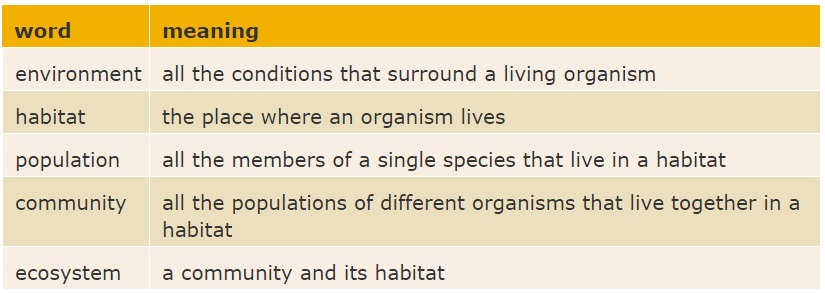
For example, a pond ecosystem consists of a pond habitat,
inhabited by aquatic plants, waterside plants, micro-organisms, and
herons. The organisms together make up a community of living things.
COMPETITION
Habitats have limited amounts of the
resources needed by living organisms. Organisms can only survive if they can
get enough resources. They must compete with other organisms for these
resources. If they are unsuccessful and cannot move to another habitat, they
will die.
Animals
Some of the resources that animals compete for:
Animals
Some of the resources that animals compete for:
- food
- water
- space
Animals may also compete for mates so
that they can reproduce.
Plants
Remember that plants make their own food
using photosynthesis, so
they do not compete for food. Some of the things that plants do compete for
are:
- light
- water
- space
Life in the heights
Tropical rainforests cover only 6 % of the Earth's surface but yet they contain MORE THAN 1/2 of the world's plant and animal species!
Tropical forests contain more species than any other ecosystem, and a higher proportion of unique species. As people cut off large areas of tropical plants and trees, entire species are vanishing forever.


Watersheds of Spain
There are three watersheds in Spain:

The Atlantic watershed carries water from the rivers which flow into the Atlantic Ocean.
- The Galician rivers are short with high flows because of the abundant rain.
- The plateau rivers (Los Ríos de la Meseta) are long with high flows too. However, the flows are lower in the summer when there is little rainfall.
- Atlantic rivers in Andalucía (Andalusia) are long with irregular flows.

The Mino (Miño) River

The Tagus (Tajo) River passing through Toledo (Spain)

The Guadalquivir River passing through Seville
The Cantabrian watershed carries water from the rivers which flow into the Cantabrian Sea (Mar Cantábrico). It has short rivers. Their flow is abundant and regular because they go through areas with a lot of rainfall.

The Bidasoa River (Basque Country)

The stone bridge over The Sella River in Cangas de Onís (Asturies)
The Mediterranean watershed carries water from the rivers which flow into the Mediterranean Sea. It doesn't have many rivers. They are short with low, irregular flows, except the Ebro River.

The Stone Bridge over The Ebro River in Saragossa (Zaragoza) (Aragon)

The Turia River
The Relief of Aragon

IDEDidáctica JUEGOS (CLIC ON)
RÍOS DE ARAGÓN (CLIC ON)
Human Reproduction
All living things reproduce, or create offspring. Animals’ offspring are often called babies. The body parts that allow animals to create babies belong to the reproductive system.

Types of Reproduction
Some animals can create offspring through asexual reproduction. This means that one animal creates offspring on its own. For example, corals, hydras, and starfish can reproduce through a process called budding. In budding, a growth called a bud breaks off from the animal to make a new animal.

Most animals use sexual reproduction to have babies. This means that two sex cells, one from a male and one from a female, join together to create a baby. In some animals, including many types of fish, the male and female sex cells join together in water, outside the female’s body. In other animals the sex cells join together inside the female’s body.

After the sex cells join they grow into a baby. The babies of most mammals develop inside the female’s body. Like other mammals, humans reproduce sexually. A woman’s body supports a baby as it grows. For these reasons men and women have different reproductive organs.

Puberty
Digestion

Our body needs food to provide it with energy, vitamins, and minerals. However, in order use food, we must first break it down into substances that the various organs and cells in our body can use. This is the job of our digestive system.


