Our social:

Latest Post

Showing posts with label Natural Science. Show all posts

Physical vs Chemical Changes


Chemical changes make chemical reactions and the creation of new products possible. Typically, a chemical change is irreversible. In contrast, Physical Changes do not form new products and are reversible.

⭐Here are some examples of Chemical Changes:
  • The rusting of iron
  • Combustion (burning) of wood
  • The metabolism of food in the body
  • Cooking an egg
  • Digesting sugar in saliva
  • Baking a cake
  • Using a chemical battery
  • The explosion of fireworks
  • Rotting bananas
  • Grilling a hamburger
  • Milk going sour


A physical change is a type of change in which the form of matter is altered but one substance is not transformed into another. The size or shape of matter may be changed, but no chemical reaction occurs.
⭐Examples of physical changes include:
  • Crumpling a sheet or paper (a good example of a reversible physical change)
  • Breaking a pane of glass (the chemical composition of the glass remains the same)
  • Freezing water into ice (the chemical formula is not changed)
  • Chopping vegetables (cutting separates molecules, but does not alter them)
  • Dissolving sugar in water (sugar mixes with water, but the molecules are not changed and may be recovered by boiling off the water)


⭐Watch the video to know more:


⭐Take the practice quizzes below to see what you need to know before the test. Click on the link below:

Review and Practice

Physical and Chemical Changes


⭐Play the game:


Matter!


Matter is everything around you. Atoms and molecules are all composed of matter. Matter is anything that has mass and takes up space. It is actually the amount of stuff in an object. 


Even though matter can be found all over the Universe, you will only find it in a few forms on Earth. We cover five states of matter here. There are many other states of matter that exist in extreme environments. 

Light


Light is a form of energy which our sense of sight can detect. It is made of electro-magnetic radiation and travels in a straight line. Red, green and blue are the primary colors of light. Mixing them in various ways will make all other colors, including white. 


World Ecosystems

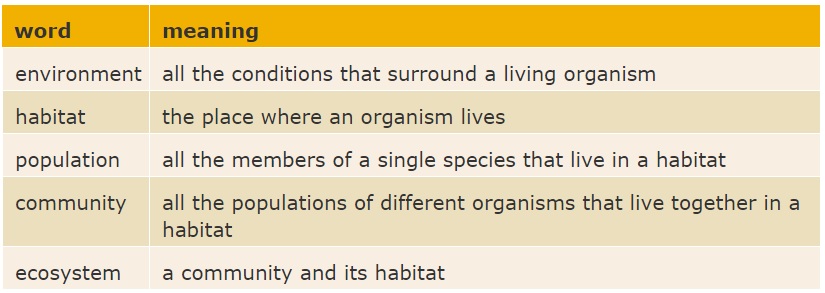
An ecosystem includes all of the living things (plants, animals and organisms) in a given area, interacting with each other, and also with their non-living environments (weather, earth, sun, soil, climate, atmosphere). These plants and animals depend on each other to survive. 


Ecosystems and their components

An ecosystem describes a specific area where the organisms work together as a unit. It could be any size from a tiny pool of water to hundreds of square miles of desert.
A biome is way to describe a large group of similar ecosystems. Biomes have similar weather, rainfall, animals, and plants.


ECOSYSTEM IS BALANCE AMONG SPECIES

Ecosystems maintain important balances in order that all the organisms within the ecosystem can survive. These balances involve food, water, oxygen, nitrogen, and carbon. The sun provides the energy needed by ecosystems. Plants take this energy and use photosynthesis to create sugar which they can use for energy. Nutrients in the soil, the air, and water also play a part in keeping an ecosystem thriving and in balance. 
Humans have affected many ecosystems and biomes throughout the world. Cutting down trees, developing land, growing crops, burning fossil fuels, overfishing, and overhunting are just some of the ways that we have affected the balance of nature. 


LAND BIOMES


MARINE BIOMES

There are two major aquatic or water biomes, the marine biome and the freshwater biome. The marine biome is primarily made up of the saltwater oceans. It is the largest biome on planet Earth and covers around 70% of the Earth's surface.


FRESHWATER BIOMES


The freshwater biome is defined as having a low salt content versus the marine biome which is saltwater like the ocean. 
There are three main types of freshwater biomes: ponds and lakes, streams and rivers, and wetlands. 


CORAL REEF BIOME

Click HERE to know about the Great Barrier Reef


HABITAT/POPULATION/COMMUNITY

Animals and plants have features that allow them to adapt to their environment. The organisms in a community compete with each other for limited resources, including water and space. Plants also compete with each other for light and minerals.


For example, a pond ecosystem consists of a pond habitat, inhabited by aquatic plants, waterside plants, micro-organisms, and herons. The organisms together make up a community of living things.

COMPETITION
Habitats have limited amounts of the resources needed by living organisms. Organisms can only survive if they can get enough resources. They must compete with other organisms for these resources. If they are unsuccessful and cannot move to another habitat, they will die.


Animals

Some of the resources that animals compete for:
  •          food
  •         water
  •         space

Animals may also compete for mates so that they can reproduce.

Plants
Remember that plants make their own food using photosynthesis, so they do not compete for food. Some of the things that plants do compete for are:
  •         light
  •         water
  •         space

Life in the heights

Tropical rainforests cover only 6 % of the Earth's surface but yet they contain MORE THAN 1/2 of the world's plant and animal species! Tropical forests contain more species than any other ecosystem, and a higher proportion of unique species. As people cut off large areas of tropical plants and trees, entire species are vanishing forever. 


Digestion


Our body needs food to provide it with energy, vitamins, and minerals. However, in order use food, we must first break it down into substances that the various organs and cells in our body can use. This is the job of our digestive system.

Respiration


The human respiratory system contains the organs that allow us to get the oxygen we need and to remove the waste carbon dioxide we don't need. It contains these parts:

Circulatory System

Made up of the heart, blood and blood vessels, the circulatory system is your body’s delivery system. Blood moving from the heart, delivers oxygen and nutrients to every part of the body. On the return trip, the blood picks up waste products so that your body can get rid of them.


Excretory System

As your body performs the many functions that it needs in order to keep itself alive, it produces wastes. These wastes are chemicals that are toxic and that if left alone would seriously hurt or even kill you.


The Water Cycle

   
The earth has a limited amount of water.  That water keeps going around and around and around and around and ... in what we call the "Water Cycle".


Voyager 1 goes beyond Solar System!

Voyager 1 has gone where no spacecraft has gone before. It has left the solar system! That’s the first time ever a spacecraft has gone that far. 


There’s nobody on board Voyager 1, of course, but it is sending back data, although it takes us 17 years to get every message… no matter how old the technology it was made with is (it dates back 37 years ago). Today a quite basic smartphone stores more data than the Voyager... It is the size of a small car.

How big is the universe?

The universe is a big, big place. But how big? And how do we know?

Generations of explorers have looked very deep into the expanse of the universe. And the journey continues today. The distance from the Earth to the Sun has helped us to find the true scale of the entire Solar System.

When we leave the Solar System, we find our star and its planets are just one small part of the Milky Way galaxy. The Milky Way is a huge city of stars, so big that even at the speed of light it would take 100,000 years to cross it all the way. All the stars in the night sky, including our Sun, are just some of the residents of this galaxy, along with millions of other stars.

Solar System Amazing Facts!

The universe is more amazing and vast than you realize and these truths will definitely teach you something.


The Five Kingdoms

Scientists believe that there are over 10 million different kinds of lifeforms, or species, on Earth. Imagine trying to study and understand the lives, patterns, behaviors and evolution of so many different kinds of organisms. Scientists start by classifying lifeforms in groups called kingdoms. 

These kingdoms represent a very large group of lifeforms that are all similar in some ways, but can be very different from one another in other ways. The five kingdoms that biologists have developed are the Monera Kingdom, the Protist Kingdom, the Fungi Kingdom, the Plant Kingdom, and the Animal Kingdom:


# 1: Fungi


The Five Senses

Do you hear that? What is that smell? Let me see that. What is that taste? Do you feel that? Although we may use these questions quite often, it may be hard to define what each sense is. You use your sight, hearing, tasting, touching and smelling senses everyday. They are so common that one doesn't even know they are doing it. 


What Are the Five Senses? 

Our senses allow us to experience the world around us.The senses allow us to see, hear, smell, taste and touch things. Each sense is associated with a specific sensory organ.
  • The eyes give us the sense of sight.
  • The ears give us the sense of hearing.
  • The nose gives us the sense of smell.
  • The tongue gives us the sense of taste.
  • The skin gives us the sense of touch.

The eyes and sight

Your eyes give you the sense of sight. This sense is normally the one that we use the most as it allows us to see. Your eyes capture light and converts it into images for the brain to process. Sight allows us to see the size, form, color, and location of things that are around us or in our environment.
To take care of our eyes we should read in good natural light and avoid spending too much time in front of a screen.

The ears and hearing

Your ears give you the sense of hearing. This sense allows us to hear or listen to sounds that are around us. You can hear music and listen to people talking because of your sense of hearing.
To take care of our ears we should listen to music at moderate levels and avoid inserting objects into the ear which may damage it.

The nose and the sense of smell

Your nose gives you the sense of smell. This sense allows us to smell and distinguish the different aromas (or smells) that things have. The smell of a rose is pleasant. The smell of garbage is stinky.
To take care of our nose we should keep it clean as this helps us breathe better and to perceive different smells better. Do not insert objects into the nose that may damage it.

The tongue and the sense of taste

Your tongue gives you the sense of taste. This sense allows us to perceive the flavor of the things we eat or drink and allows us to identify if it has a sweet, sour, salty, or bitter taste.
To take care of your tongue, it is important to have correct hygiene inside the mouth with includes brushing your teeth regularly.

The skin and touch

Your skin gives you the sense of touch. This sense allows us to feel how something is and know its texture (smooth or rough), it’s hardness (soft or hard) and its temperature (hot or cold) when we touch it.
The skin is a thin layer that covers and protects our body. Did you know that our skin is the largest organ of our body?
To protect our skin, it is important to use sunblock when we are outside and to wash ourselves every day.


Levels of Organization

Definitions of each of the levels of organization in the human body are a click away...


Cells

Animals and plants are made of cells. Cells form the basic "building blocks" for living things. 

Cells are very small. They are the basic building blocks of all animals and plants. This photograph shows cells seen through a microscope:

How seasons work


Not everybody knows what exactly causes the changes of the seasons. Some people think that it's wintertime when the Earth is further away from the Sun which is why is cold. However the Earth's orbit is almost a perfect circle. The real reason is the Earth's axis. The Earth is tilted and it is winter in the nothern hemisphere, when the nothern hemisphere is tilted away from the Sun. And it is summer, when it is tilted towards the Sun.